

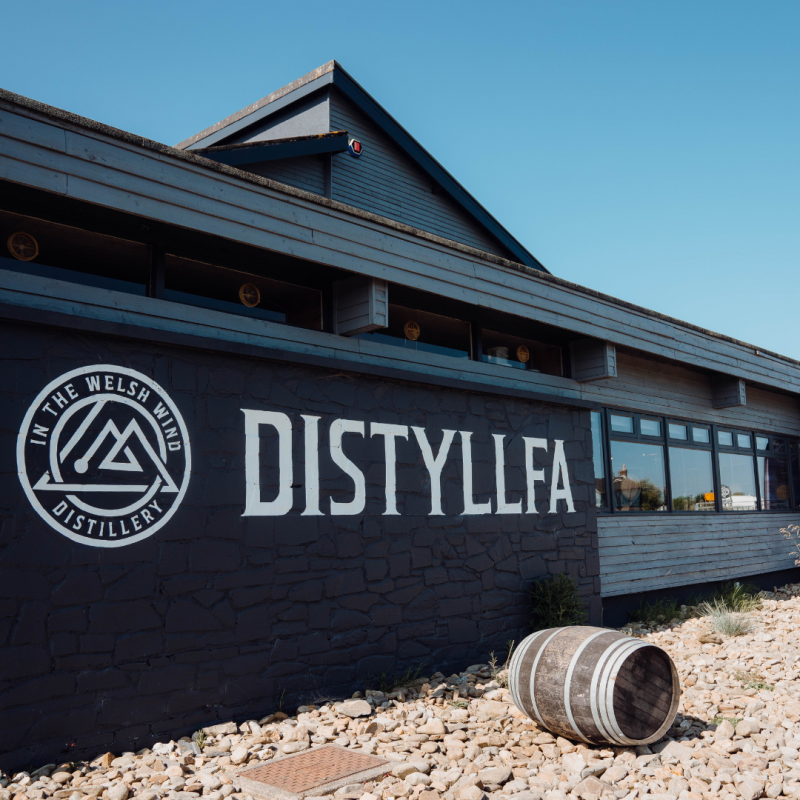
Why not spend Halloween traveling deep into West Wales? Winding west form Shrewsbury on the train, I retraced steps I last took in 2019, heading to Aberystwyth. From there, a TrawsCymru bus took me along the wet coast of Ceredigion to In the Welsh Wind. You may remember that I posted a blog about them back in 2024 , when they kindly sent me a sample of their first whisky.
However, that was produced using regular malt, not the unique approach they have developed since then. The history of it takes some explaining, but that's why I was there - I needed to learn! What makes this distillery different from the handful of other outfits in Wales (most notably the bear-moniopoly of Penderyn)?
While the distillery was first started in a lockup two miles away, it now lives in a much nicer home, the former Gogerddan Arms . This pub's name is still used for the bus stop just across the road. A grey-blue building facing the Arms was also a coaching inn and brewery back in the day - back when this was the only road linking Aberystwyth and points south.

In the Welsh Wind was started up by Ellen and her partner Alex. Driving around the North Coast 500 with their toddler in tow, the two had stopped near Gairloch and seen Badachro Distillery . Observing the use of local botanicals, and whisky-making on a very small scale, they thought about changing trades. Alex was a baker… but then fate stepped in. He became gluten intolerant: not ideal for a baker!
The couple took that germ of an idea observed at Badachro, and by 2018, they were distilling. Sally emphasizes the role Alex's palate played in shaping IWW's first spirits: this is a distillery guided more by personal vision than a marketing plan. Bruichladdich also influenced IWW's early development (much like Old Well ), and Alex did a stint of work experience there too.
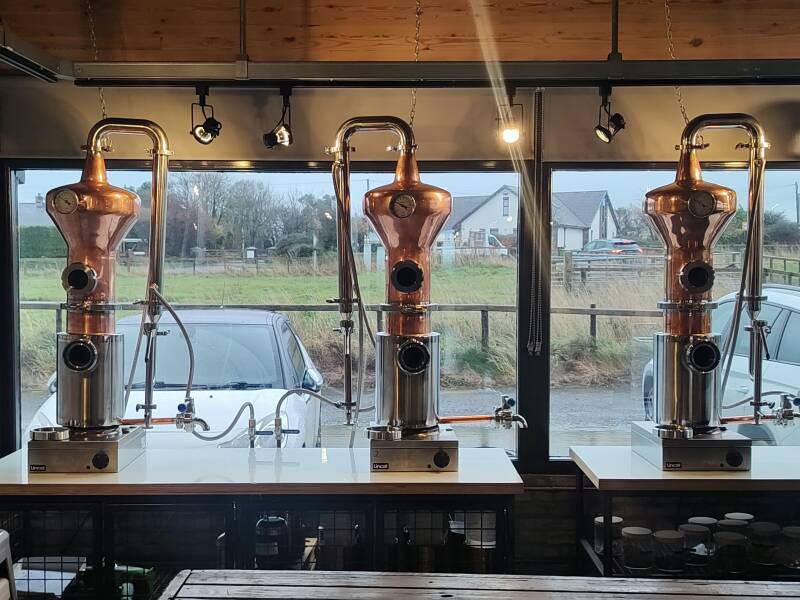
Using an 80% ABV base spirit, Alex and Ellen produced gins on two stills: the 50L Meredith and 200L Afanc . Some vodka and rum later (including cask-aged rum), and In the Welsh Wind was off to the races. Their range expanded to include an apple eau-de-vie recently, and IWW became the first distillery in Wales to offer gin-making experiences . Alex even designed the unique small stills for these himself!

How well do Welsh whiskey distilleries get along? IWW are reasonably friendly with Hensol Castle , apparently (and HC apparently use Tiny Rebel produce their wash). Penderyn has also been supportive.
Gin is IWW's pride and joy. A little like Spirit of Hven, IWW does some consultancy and white label bottling, such as Matthew Vaughn's gin . They also bottled some gin aged in palo cortado casks…

When they won their first award, IWW found themselves needing to fulfill 100,000L of demand with just their basic 500L iStill. They're still a small outfit today, with only 16 employees total.
While IWW moved to this location in 2019, they only opened up on 15/03/2020… if you think about that date for a moment, you'll know what was just days around the corner. They relied on help from the Development Bank of Wales to get them through the pandemic.
It's funny to note that (as with many other countries I visit around Europe), the distinction between me being a visitor from the Netherlands and being from the Netherlands myself are also lost on Sally. It happens quite often, I just think it's funny to see it happen when we're both native English speakers too! And it's kind of a good thing - I get to see how distilleries present themselves to people from a different background.
' For us, whiskey wasn't necessarily part of the plan right from the start ,' Sally explains. Alex and Ellen weren't whiskey fans first and foremost. However, one of the most exciting things about IWW is their use of local, Welsh barley. Penderyn have never paid any attention to this (if their releases are anything to go by). Sally explains that barley is already grown in West Wales, but a lot goes to animal feed: it hasn't always been grain of the highest quality.
The first crops attempted by the distillers here also were not great, so they got in touch with an agronomist and grass expert at Aberyswyth University . They then enlisted further help from a German seed company , and Sion , a local farmer who manages the fields in front of the distillery. I notice when I'm present (in late October, post-harvest) that the field is full of mustard plants, grown to regenerate the soil.
With guidance on the right strains of barley to grow for local conditions, Sion cultivated a crop which was dried for a year in his sheds before being hauled up to the distillery, one tonne at a time. Only issue is, they ran out of this first barley batch quickly, and the 2024 harvest was poor . The 2025 harvest, finished just before I visited, was thankfully better. Sion also gets the trot in return for his efforts growing this barley.
Walking into their whiskey making space, I notice there's a distinct cheesy funk to it. Not an off note, but very distinctive. Turns out I'm standing in the room which also functions as their malting floor ! In the corner, there's a tank where the barley steeps before being laid out for a traditional floor malting. A big challenge has been the poor temperature control of the building; an old pub isn't designed to also be an efficient maltings. IWW did initially try to kiln their malt in an old shipping container, but apparently that was no good.

Looking for a solution, IWW came upon a New York distillery using green malt ( likely this one ). I expected their big inspiration for using green malt to be Irish whiskey, but apparently not! You can see how IWW have found their way to their current approach through an organic mix of trial and error . It's extremely charming and *real* in an age when enormous new Scottish distilleries are so generic they could have rolled off a production line.
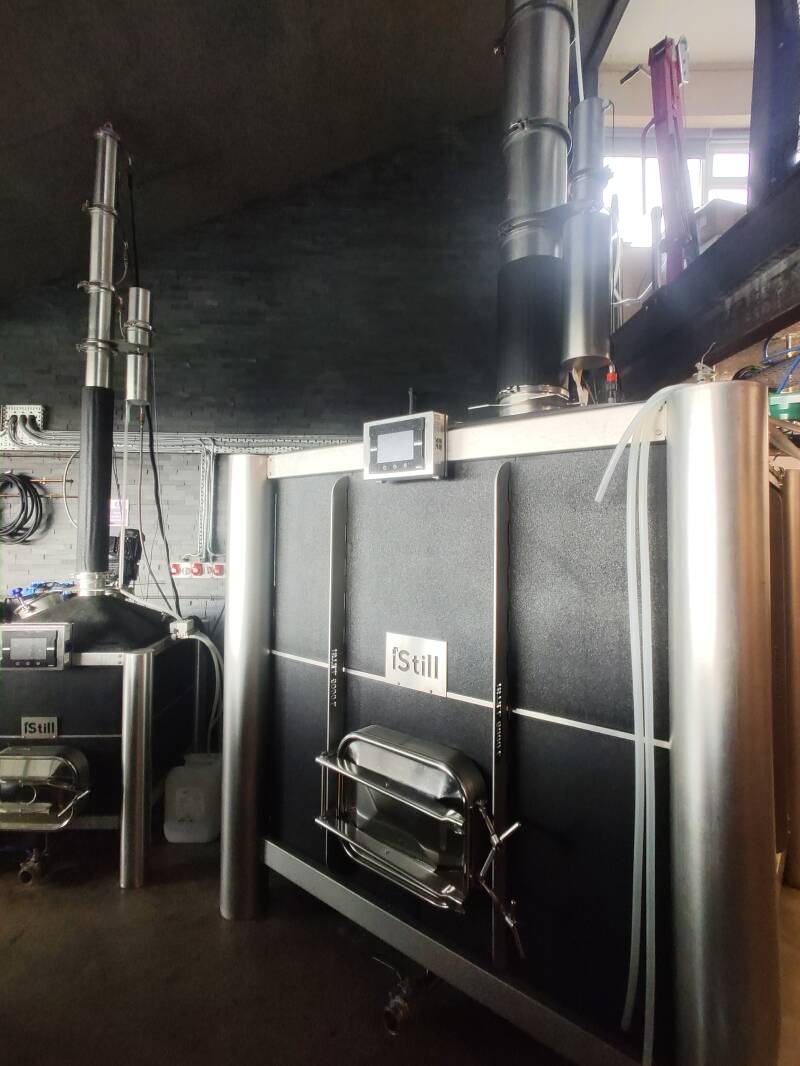
Regular malt mills assume you have hard, dry, kilned malt, so they don't like chewing on soft, wet, unkilned 'green' malt. IWW adapted a meat mincer into a special mill for themselves. They also performed spectrometry analysis of their local barley, inspired by Waterford's terroir studies. Their iStill is a combined washback and still, with integrated condenser and all. The heating and tails receivers are also held within the box frame. The original 500L iStill now sits in the corner, superseded by a 5000L unit.
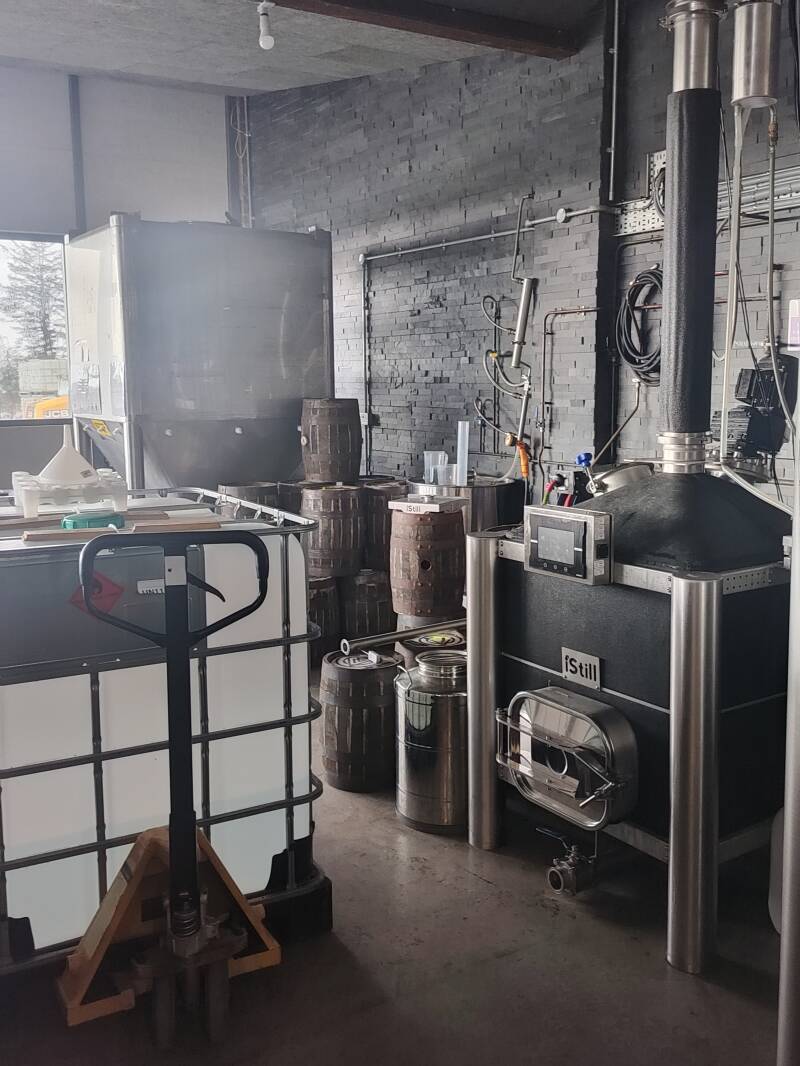

Currently, all IWW whiskey casks sit in racks in this same room. Only 200L of private casks were laid down when I was there! Some further storage is being procured a few miles away, so there should be some more space in here soon (alongside other upgrades to the IWW premises). While Sally couldn't give me an exact figure, she can tell me the angels' share here is very low . It makes sense for such a damp and cool area, facing the Irish Sea / Atlantic Ocean only 2.3km away.
It's been a long journey of working out the kinks and grappling with the unique flavors of green malt. IWW now has some aging in 30L casks, and some palo cortado seasoned wood too. I never need convincing to use Palo Cortado casks, but thankfully, there was more thought to it than that. In testing various options, IWW found that palo cortado apparently works really well with the specific aromas and congeners produced by green malt!

Beyond that, IWW is very self-contained: all their bottling and labeling is also in-house . The distillery premises are currently quite small, with little separation between customer and production areas, so these upgrades should make things feel a bit more up-to-scale.
The IWW plan is not to focus on age statements , or large scale whiskey production. Not only is that not practical for them, they point to Penderyn: they've been going for over 20 years now, with much larger quantities of spirit, and still no sign of an age statement in the Aur Cymru range.
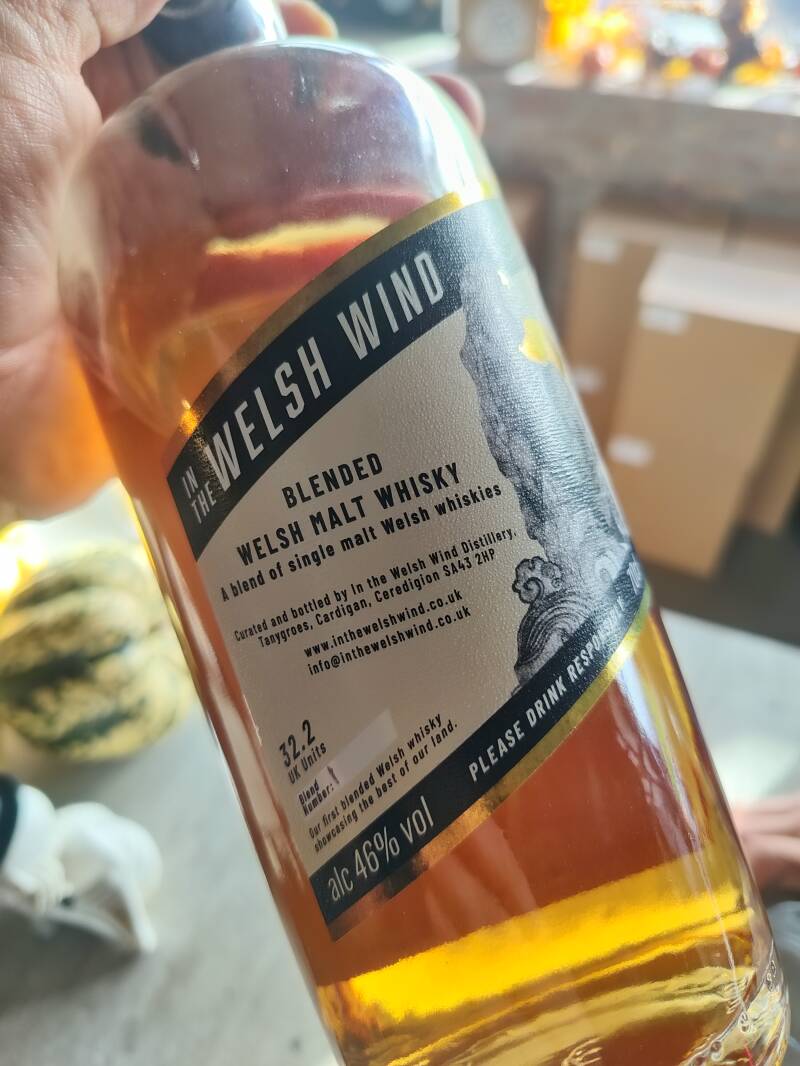
IWW launched a Welsh blended malt, the Brychan . It's a reasonably light, young whiskey that's suitable for a wider market, balancing spirit from several Welsh distilleries. It doesn't contain any of IWW's own green malt spirit, as all that is being saved for their own Welsh Origin bottlings currently aging in casks. In fact, what little whiskey IWW has put out so far came from earlier batches made using more reliable, bought-in dry malt.
Tasting the Brychan, I find it has a nicely tangy, malty taste; an orange, savory, heavy body to it. To be a little spicy for a moment, it's like Monkey Shoulder if it was really good. The finish carries through very well. Overall, it's a simple but very pleasant whisky!

Thankfully, I also got to taste the Sibrydion Da - a little special sample held back at the distillery, not part of any official release. Sibrydion Da means 'Good Rumours', by the way. This 58.4% ABV sample of green malt spirit, aged just over three years in ruby port… WOW. Nothing tastes like this!

It's funky and cheesy in a gorgeous way (and that's coming from someone who doesn't eat cheese of any kind). Some floral mint notes float over the heavy heat of the young spirit. Somehow, that initial floral cheesyness morphs into a chocolate note, but still sour, almost like you're tasting the pre-roast fermenting cocoa beans… Whatever mix of flavor comes from using green malt, or comes from the unique local barley terroir… it's unique, fascinating, and tastes great!
While IWW is a small distillery, it's doing whiskey a different way, and I always appreciate that. Keep your eye on it for a future addition to the whiskey palate which only a few Irish distilleries (and Ed Gwenn ) really gesture to at the moment! Thanks to Sally for taking me round the distillery, communicating with me from the start, and to Joe for giving me a lift over to nearby Da Mhile (hope you had a good Halloween night out!).
Add comment
Comments