


At the end of September last year, I went to the Basque Country for the first time. Besides giving a tasting at Edari in Bilbao, I used the opportunity to see a distillery. What else do you think I would get up to?!
Taking the commuter train from Bilbao out to the town of Amurrio, I was immediately struck by the station’s architecture: stone and whitewashed walls, timber frames, and the classic Basque ‘harri’ typeface everywhere. Amurrio is very close to the source of the Nervión river which flows through Bilbao, as well as the Salto del Nervión (Iberia’s highest waterfall).
Even better, I could see the distillery from the train station. Not since I visited NORDIK in 2023 have I had such an easy time getting from the train station to a distillery. The location of Acha is key to its history - having Amurrio station right behind them is no coincidence! Being so well connected has some advantages, but it has also forced Acha to spend fifteen years pushing for an expansion which was finally underway when I arrived.

I initially took a wrong turn and thought this was the entrance… turns out, Google Maps sends you here while this old entrance is no longer in use! We’ll come to the ‘Museo de Licor’ part later…

It also turned out that my visit was initially planned with an intern who didn’t write it in the calendar properly, so nobody knew I was coming! This, I reminded myself, is why it's always a good idea to send confirmatory emails the week before you travel…
Thankfully, the staff were able to help me, and I even got a tour from Gabriel Acha. Gabriel’s family bought the company many years ago, and the letter of purchase signed by Manuel Acha still hangs on the wall. The old owner was retiring, and his sons didn’t want to take over - so the distillery remained a family owned business, it just became a different family!
The company was originally founded by a Bordeaux businessman back in 1831. There are well-established historical ties between the ports of southwestern France and the Basque country, and this guy had a lot of cognac-drinking customers here. The man in question wanted to produce cognac for export: demand was high, and there was nothing stopping him from making ‘cognac’ in the Basque Country back then. Those laws only arrived in 1906, and by then many other spirits were being produced here, so the business didn’t have to close. French original owner was from Bordeaux, had a lot of cognac customers in this area so wanted to produce it locally
There are only 12 people working at the distillery… not a lot when you consider how many different products they have! Acha still produces a lot of different product lines today, the newest being vodka which was only set in motion by Gabriel himself 25 years ago. These include Karpy (a triple sec competitor), bitters, vermouth, and the Basque spirit patxaran.
DETAILS
- Double distillation using 2000L hybrid still (3 plates)
- 140 year old stills used for other products!
- Wine/cider yeast (Saccharomyces bayanus)
- 7 to 9 day ferment (unpeated) including lactobacilli
- 67ppm peated malt (Basque heather peat)
- 5000L hybrid still (replacing 2000L)
- Malt spirit distilled to 65%, casked at 60% ABV
- Grain spirit distilled to 85% and aged at 75%
- ‘Grain’ whisky = 90/10 green/malted barley
- Angels share 2%
- 20,000 bottles per year of Haran 12 increasing to 50,000
- 200,000LPA of whisky (70% of that is malt)
Unfortunately, it's not the best time for my visit. Production capacity is being increased, but that means for now that much equipment has been removed from the stillroom. Naturally, production is not taking place during my visit!

Two large vats are used for mashing and fermenting respectively. I am able to learn some more details about how fermentation works at Acha. Their yeast is a ‘cannibal’ yeast which eats everything and works fast at a wide range of temperatures. Unpeated malt gets a longer ferment of seven to nine days, in order to create more floral and citrus notes. Lactobacilli cultures are introduced as part of the yeast pitching, and the fermentation temperature rises from an initial 12 to 28°C over the several days of fermentation. Peated malt is mashed and fermented faster to prevent the more delicate phenols from being oxidised. Temperatures above 38°C are apparently particularly damaging to these phenols, so fermentation is held below 32.

Both peated and unpeated Basque malt are used for whisky making here, the former having a large heather content in comparison to sphagnum-dominated Scottish peats. Apparently the roots of the heather plant provide the most character for the smoke, being more vegetal and earthy than the antiseptic sharpness of Scottish peat. A final note - they use this Basque peat to smoke local malt after the initial drying.
Old stills here are still in use for gin and rum. Acha’s ‘La Morita’ white rum imitates Caribbean styles, and is supposedly the oldest such European brand still in production, having started in 1897. Acha has their own bottling line on site to handle the various product lines.
Acha’s warehouse cellar holds around 600-700 barrels. This includes using wine casks, and even a Txakoli brandy in the near future! Most Acha casks are Iberian oak, in particular coming from nearby parts of Euskadi and Navarra. It’s all part of what Gabriel calls their ‘Km 0’ approach to using local materials. As I learned more over the subsequent days, Navarra has a more Aragonese side, and a more Basque side, so the region plays a role in Basque culture which bleeds over into whisky production.

It’s not just the stillroom being renovated - the distillery’s museum is being redone to create more space and reduce humidity. So it turns out there was a ‘museum de licor’, but it's not open right now.


The picture for where Acha is going really comes into focus with Santiago Bronchales, the Haran blender who was also responsible for Aldea creating the Canary Islands’ first whisky. Gabriel claims he is one of Europe’s best blenders - big praise! Santiago first began working with Acha 24 years ago, but came on full time at the start of the 2020s. He gave them the kick to start doing whisky and (more recently) to up production levels, and has overseen distillation of every bottling save the 21 Year Old (more on that one later).
While Acha’s single malts are called Haran, their blends are called Ibar (which means river valley in Basque). They’re all bottled at 40% ABV (without chill filtering or colouring) in more squat bottles than the taller Haran. A lot of blended whiskey is being stored away for future release, and the single malts have a range of age statements and finishes. This ‘blended’ Acha whisky is only called that to imitate Scotch naming conventions. A little like Loch Lomond single grain, this is a 100% barley spirit, but it uses green barley.
Haran single malt’s main aging is new Iberian oak, with some local white wines and occasional US/French oak. All these casks are then reused for the grain whisky. Quercus pyrenaica is the most common oak species up here in Euskadi, but local winemakers tend not to use it: it's seen as too aggressive. However, quercus robur also grows here, and it provides lots of spice, leather and tobacco notes. It needs the edge taken off first, hence only second fill casks being used for grain whisky maturation.
Contrary to what I expected, whisky was actually made here quite a long time ago. Back in 1906, a distillery employee was studying chemistry in Scotland, and talked about making some whisky. As Scotch whisky became more popular in Europe after 1918, they tried getting it going here in Euskadi. Sadly, local palates still weren't up to it, and the tentative production stopped in 1926. Santiago knew about this history, and he felt it was important to try and give Basque whisky another go. He also wanted to restart rum and brandy production which had stopped in the 1950s.
Creating Haran has been a significant investment of time and money for Acha, and only now have the 12 Year Old expressions really provided much profit. The blends were more of an experiment at first, but their success has kept whiskey alive in Amurrio.
One question - Why does Acha spell whiskey with an ‘e’? A few reasons, Gabriel and Santiago say with a smile. Marketing (it stands out), helping Spanish speakers pronounce a non-native word, and a little nod to location. The ‘e’ in whiskey stands for Euskadi and Espana.
TASTING
After all that learning, it was time to get tasting. The tasting room at Acha was a bit cold for this experience - ironic, given these drams were intended to mostly be drunk in a warm climate.


The original Ibar Blend contains 15% malt spirit and is a NAS, easy to drink dram. Supposed to be clean, fresh, and suitable for mixing - yeah, Santiago’s right, it is all that. The finish actually lasts better than I expected too.

The older Ibar bottlings are intended to add both general depth and also some smoke. The Ibar 8 Year Old has a higher malt content (25%), of which about ⅕ is peated. It has a smooth texture again, with a lightly fruity note of classic single grain coming through. The smoke is super subtle, but it does add a little body to this bottling. Again, for a blend the finish is pretty good, likely reflecting the higher barley content.
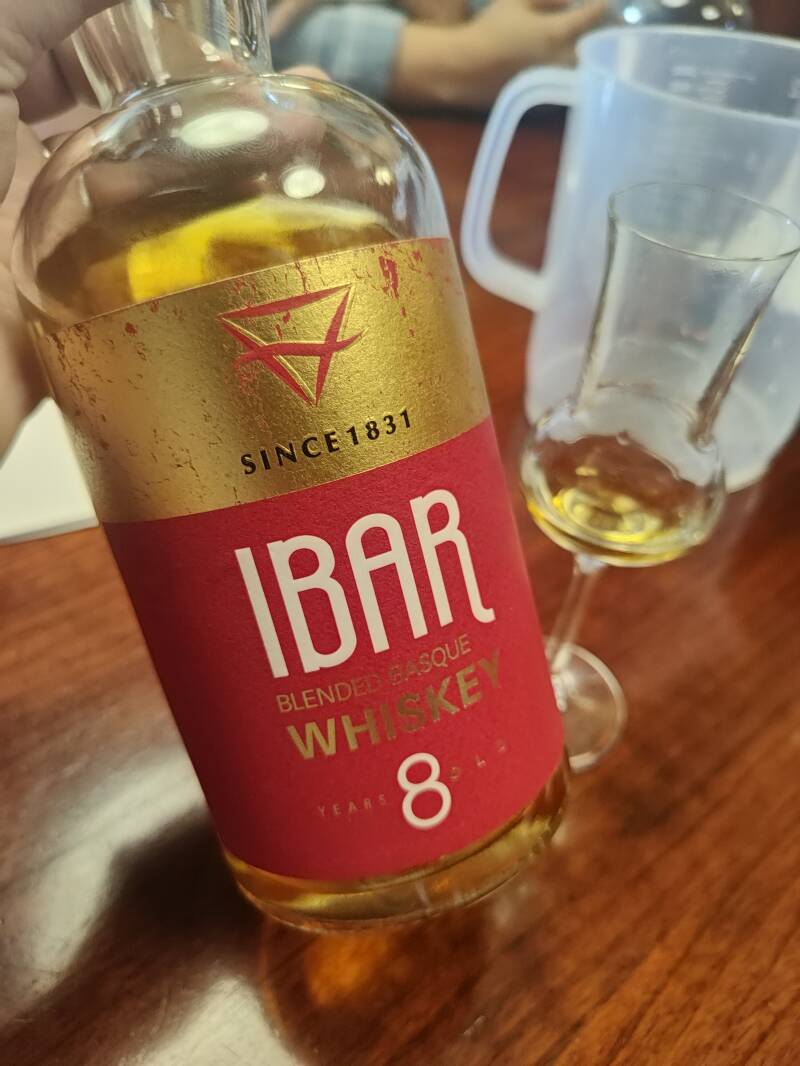
The Ibar 12 Year Old is 50/50 malt and grain whiskey, and around 10% is peated (so double the ratio of the 8 Year Old). For a blend, this is a big boy! Despite the impressive texture, I think taste-wise this is the least interesting of the three.

Moving on to the single malts, we have the classic Haran 12 Year Old (40%). This contains 5% smoked malt, according to Santiago. He suggests bready notes and lemon peel for tasting notes, with some visitors liking it to a light Scotch or Japanese style. Santiago believes Acha is threading the needle with a ‘clean and honest’ flavour.
Aged in no. 4 char casks, this dram has a very light colour for its age. Aging is quite slow here in Amurrio, with the temperate climate of Iberia’s northern coast. The Acha cellars never range beyond 10-16°C, so the wood barely shifts in temperature.

Honestly, it tastes surprisingly similar to the Ibar. A nice light dram, sure, but for twelve years old? I expect more. In fact, going back to it, I prefer the nose on the Ibar 12 to the Haran 12.
Haran is mostly sold to locals, with some small amounts going to export so far. No surprise, its style caters to local tastes (as, I’d argue, it should), and is comparable to Cardhu. The older expressions are only for small batches of whisky geeks. In contrast, Ibar has been very popular in the US.
Moving on, we have the Haran 12 Cider Cask. It spends the last two years of its maturation in 225L American oak casks, and is bottled at 43% ABV. The cider used to season these casks was a dry basque cider, and it almost makes the dram taste faintly smoky (if I didn’t know any better). Still a very gentle dram, but it definitely adds something to the finish. Nothing wrong with subtlety, but I would still like something more distinctive.
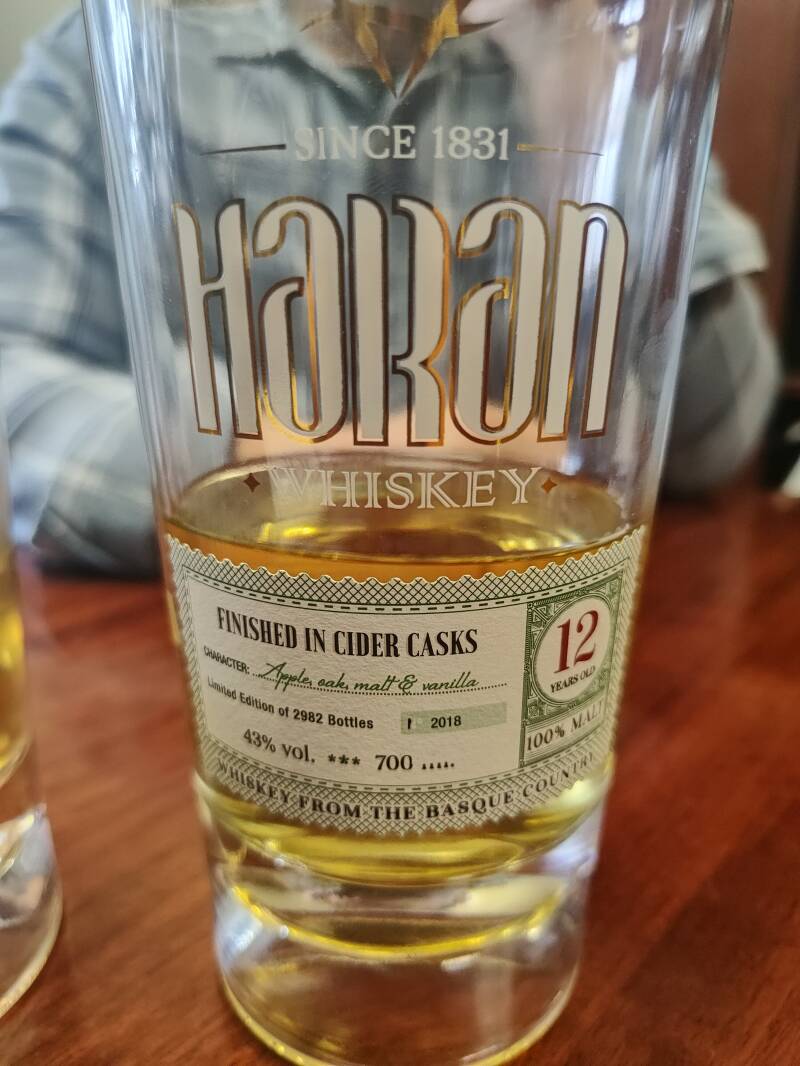
Santiago clearly senses my mild reaction to these drams, as he notes these are all first editions of Haran, produced in 3000 bottle batches. Acha’s ongoing expansion will see Ibar and Haran production continue, but with some change to Haran. Santiago wants to do something different with the cask finishes, keeping more spirit at cask strength and ageing more bottles for 12 years before finishing instead of 10. They had been hoping to launch some by Christmas, but it's 2026 now and still no sign of them online. The new bottlings would be 47-53% ABV and include a Txakoli brandy cask limited edition.
The Ibar range is able to compete with Johnny Walker on price for locals. You know how I’ve said before (or Anna Bocholtz has, and I’ve agreed with her) that European distilleries shouldn’t try to compete for that cheap end of the market, as the big players will out-produce them? Not everywhere, it seems! Thinking about the talent other Spanish distillers have shown for blends, maybe this is a niche more Iberians should lean into…
On to the Haran Port Cask… ooh, here we go! A very distinctive nose of creamy rosé port, with notes of chocolate and violets. More subtle and floral than you’d expect from a port cask, and still with a light colour. Five 300L ruby port casks were used, sourced from a very small winery and provided to Santiago via Tres Hombres. A wisp of smoke, and still a light finish, but if you’re in the market for a ‘floral’ whisky, this is excellent!

The Haran Sherry edition finishes in dry oloroso, but smelling it for the first time, it reminds me of a lovely amontillado and a bohemian honey liqueur. It's a silky first sip, with little sweetness or depth on the palate as you might expect from the influence of a sherry cask.
The palate is fascinating. This is where I mention how Santiago tries to keep his whisky from being too sweet, preferring it to have a certain acidity instead. Full of rich sherry and herbal notes but without any sweetness or bitterness. It reminds me more of amontillado or fino than oloroso, while the nose is full of butterscotch. Truly, this is one of the most unique sherry cask drams I’ve ever tried. so interesting it made me forget to take a picture...
The Haran 18 Year Old is one of Santiago’s favourites, and finally, there’s some more colour on this dram! He apparently took ten of his favourite casks and combined them to create this 45% ABV expression, and it's also the smokiest Haran so far. 2228 bottles were made. Lots of tobacco notes on the nose which carry through to the palate. For an eighteen year old, it's super smooth and the finish is good, full of heather smoke and local oak. Like lemon and dates piled on top of leather.


It's a shame it takes eighteen years for all that heather and quercus pyrenaica that Santiago was talking about to really hit this clearly. Even now, I think having this bottling at 48 or 49% ABV would really make it slap! To my mind, this is what the Haran 12 should taste like, though I understand this heavy, full expression does not match local tastes/demand.
The Haran 21 Year Old (42%) started with an imported batch of three year old Scotch whisky. This was then matured here for eighteen more years, meaning this is an interesting dram but not Basque whisky: Santiago is thankfully clear on that. The fact this bottle has the standard Haran labelling is a bit lazy, but I can see now that it wasn’t malicious. This is a niche Haran product any way - most people don’t get near it!

So despite my bad luck with directions and calendars when I arrived, this was a great distillery visit! Thank you to all the staff who took my confused phone call, to Gabriel for his time at the last minute on a weekday, and to Santiago for talking me through the whole range. They also very kindly let me take this Haran 18 Year Old, so I will definitely be showcasing this to other whisky fans. Thanks again everyone!

Add comment
Comments