


As soon as I finished visiting R. Jelinek in the morning, it was off to Olomouc on the train. Leaving the edge of the Carpathians, I headed for this historic Moravian city to see a much smaller Czech distillery: TOSH. A few trains, trams, and buses later, I was standing in Těšetice, the true genesis / ground zero of Czech whisky.
The Gold Cock brand was established here, before its death and resurrection by R. Jelinek in the 2000s. Hammerhead whisky was originally distilled here as well, and that’s still the main Czech whisky most people have heard of! From the outside, TOSH always seemed to me like a new, hipster-y brand which didn’t form such a big part of the wider picture.
Having visited, I can safely say that my mind was changed! TOSH inhabits the oldest working whisky distillery in Czechia (or Slovakia, for that matter). The other big names all started later (Old Well) or used to only do brandy (R. Jelinek). I was given a tour by owner and distiller Jiří Omelka.
His whole ethos here is to make a whisky which is ‘absolutely local’. All the barley is grown by local farmers, and malted just 30km away. They use Tosca and Overture barley varieties. The former is popular in Czechia and Slovakia, while the latter was developed for Scottish whiskymakers. Funny enough, it never found much favour there, and now grows in Moravia to help make TOSH whisky. Local breweries also use it due to the high sugar (and thus yield) that can be extracted from it. Jiří is clear about his desire to make Moravian whisky, not Scotch whisky.
In my Czech Whisky article for Whisky Magazine, I noted how Czechia contains both a longstanding beermaking tradition and a great source of wine casks, but it goes further than that. Jiří points out that Moravia specifically is right on the wine/beer line which runs east-west across Europe. It’s the ideal place to synthesise both culinary traditions in its whisky.
Jiří contrasts his Moravian focus with what is going on at Old Well. ‘All respect [to them], great work… but it's a Scotch whisky made in southern Bohemia… I want to make things that make sense - it doesn’t make sense for me to get expensive [malt] from outside the country… With all respect to Scottish tradition, let’s make a local product that you can recognise in the glass’.
TOSH’s long, eight day ferment ramps up the fruity esters in their wash, further contributing to their Moravian whisky style (as Jiří tells it). In fact, it doesn’t stop there. This wash is then split into batches and distilled over six days, allowing lactic acid to build up even further. Their new make is full of citrus aromas, rather than the maltiness you would expect with a shorter ferment.
Lots of people say they want a fruity whisky, but this is real commitment to that end and a real motive behind that beyond marketability. After all (Jiří notes), people around Olomouc are used to slivovitz: they want some echo of that fruitiness in their whisky too. At time of writing, the wort has to be brought in from a local brewery, but that should change in the near future: everything will be done in-house.

DETAILS
- 8 day fermentation; distillation over 6 days
- Combination of M1 and ‘fruity’ yeasts
- 850L and 350L pot stills
- Stills run slow - narrow heart cut
- 200 barrels filled per year (theoretical capacity 350)
- Maturation at 10-17°C, 85-95% humidity
- 2.5% angels’ share
- Equivalent to approximately 50,000 litres per year (or theoretical 87,500)

Back in the ‘70s, there were five 16,000L washbacks here: two survive today. Their stills are also of a similar vintage - they’re one of my favourite parts of the whole distillery tour! You can still see ‘ČSSR’ imprinted on the exterior shells, referring to the Czechoslovak Socialist Republic (ČeskoSlovenská Socialistická Republika). The one that looks like a little lunar lander is used for gin distillation.


These Vostok-esque stills owe their distinctive shape to this stillroom’s low headspace. Despite their brushed steel exteriors, their necks are full of copper coils; 16m2 of surface area squeezed in for spirit refining and reflux.

All the way back in 1596(!), monks from Olomouc built a brewery here. The oldest building here still has incredibly thick walls, a legacy of heavy late-medieval construction which insulated the beer brewing inside. Descending into this cold, musty basement of the original monastic brewery, you can see how this used to be an enormous facility back in the day.


The space acts as a lager, and you could compare the effect of this consistent cool/humid maturation to a Scottish dunnage warehouse: Jiří does call it a ‘small Scotland’. While this cellar was built on a very impressive scale for the time, it wasn’t designed as a modern whisky warehouse. TOSH is going to run out of space soon, so they’ll be finding more storage space soon, I suppose!

There are private casks here, and Jiří tells me how he sold his brewery to help finance TOSH. The private casks have been a great source of investment cash here, and TOSH has taken its time, letting the distillery remain relatively small rather than jumping on unsustainable initial mass investment. The same couldn’t be said for Trebitsch distillery, but that’s another story…
The old distillery in Těšetice was also home to another historic Czech whisky brand besides Gold Cock and Hammerhead: King Barley. However, this brand actually stayed here, and is produced by TOSH today! R. Jelinek was offered the chance to buy King Barley but turned it down, along with Jakomarus (a herbal liqueur). Back in the 80s, 12,000L vats were used here to ‘age’ wheat spirit before it was diluted with proper casks of malt spirit. King Barley was made in a similar way, but with a higher malt ratio.

The TOSH cellars are full of casks with colour-coded ends: blue for first fill bourbon, red for 250-300L STR casks, white for experiments, and no colour for new oak (though those are quite rare here). Until recently, their largest cask was 500L (also STR), but now some old 670L, recharred cognac casks have taken that spot.


TOSH’s STR casks are very active, and provide a lot of colour! In fact, they can’t age anything in these casks for more than five years: the STR is just too active. These are local Moravian fortified wine casks, made using European oak (mostly from Spain and Portugal).
Czech STR casks aren’t just a great source of local flavour - they’re practical, costing only (approximately) 5000CZK (€200). It took a lot of experimenting with toasting levels for TOSH to get to this point and have casks they are 100% happy with, but that patience is really paying off now.
TASTING

The (three and a half year old) Lafayette combines both European and American oak. Unpeated, it has a sweetness and malt style which is very Scotch-esque. It tastes older than its age, that’s for sure! Only the finish gives away how young this whisky really is.

Very generously, Jiří draws me a sample from a 220L fortified wine cask, clambering up to get it in the process. Despite naturally being cask strength, this dram really doesn’t feel too over-strong, nor too tannic. There’s a lot of sweetness… I also get a sample of cask strength Lafayette (62% ABV), which almost smells like gin. The taste is more what you would expect, but it somehow retains a hint of juniper among the sweet punch on the palate.

Cask samples without a commercial release are labelled a little cryptically, but it’s easy enough to work out some of what they mean. L Am B D = L(afayette) Am(erican oak) B(arrel)… the D, I’m less clear on. This is purely the American oak half of what becomes the full, final Lafayette bottling - at 61% ABV cask strength. Anyway, this has a lovely sweetness which makes the connection to the regular 44% ABV Lafayette very clear. As it fades, nutty Czech oak notes somehow appear, despite it not appearing anywhere in this whisky’s production process…
Why name a Czech whisky after the famously French Marquis de Lafayette, known by most for his role in supporting the American Revolution? Well, Lafayette was chased out of France during his own country’s revolution - he was an aristocrat, after all. In the then Austro-Hungarian empire, he was caught and imprisoned in the fortress of Olomouc. Lafayette’s escape attempts were foiled, and he spent years there before his eventual release.
So Lafayette is, in a way, a local figure! There’s still a Hotel Lafayette in Olomouc today, and his ties to both France and the USA also make a lot of sense for this particular whisky: it ages in both French and American oak. The idea is to make a simple, accessible whisky with a fun image that also ties into the local area, and I think TOSH has nailed it.

The other half of Lafayette, the French oak L Fr D (also 61% ABV) is reallllllly good! The fact this tasting is being coincidentally paired with David Gilmour’s On An Island, playing on the distillery’s radio, really enhances the experience further.
I love the French oak in here - it’s what gives the depth of nuttiness that I found a hint of earlier. While I mistook that for the Czech oak notes I’d been tasting earlier that day at R. Jelinek, the explanation likely comes from the specific type of ‘French oak’ used here. Trees from Limousin are more often quercus robur, while the Allier/Tronçais forests are mostly quercus petraea: the same species normally harvested for oak casks in Czechia.

We move on to the many experimental varieties of King Barley (and the more normal varieties too!). Jiří describes this expression as a work in progress, having gone through many permutations to soon settle on its final, ultimate formula. King Barley Peated comes from older batches of malt spirit, made using bakers yeast. This is the first whisky TOSH ever made! They have two samples of this for me to try, one finished in marsala and the other in new US oak.

Czech peat can come from two areas, Jiří shows me - southern Bohemia (quite close to Svachovka, in fact) and north-western Bohemia. The former has big chunks of wood in it, while the latter is what TOSH (and R. Jelinek) uses. Furthermore, Jiří explains, this part of Bohemia yields two types of peat: ‘white’ (harvested near the surface) and ‘black’ (from four to five metres down). The black peat used at TOSH apparently gives a sweeter, caramel-like smoke and a specific mustiness.
In comparison, Jelinek uses a lighter and woodier fraction of this peat, extracted from more shallow strata of the soil. Jiří can’t confirm if both distilleries are getting their peat from precisely the same place, but he stresses that he wants to pursue it as part of a more complex flavour picture here. I agree that Jelinek’s peat style (while very enjoyable) is a bit more straightforward and in-your-face, more comparable to peated Scotch whisky.
The new US oak sample smells gin-like, but the taste is more full and toasty. The quercus alba is giving a lot of sweet support, while the finish remains gentle. The overall effect combined with peat could be compared to Cragganmore. The marsala finish adds a creamy, sweet edge with some red fruits: very welcome!

We then move to the newer style of King Barley, and a slivovica cask finish. While I was very excited to try this as something which adds an extra Czech/Moravian level to this whisky, I can see why this didn’t become part of a core range. The plum brandy flavour is clear enough that anyone who enjoys that will appreciate this, but it doesn’t gel with the malt underneath like the other samples I’ve tried.
King Barley Bourbon cask is actually more vegetal and, overall, what you expect from a young peaty whisky. Bold peat, still with that juniper-y edge. King Barley Moravian oak has a much darker aroma and a heavier, meaty kind of vegetal peat to it. A very nice depth which, in a blind tasting, would come across as a classic European oak with rich Scottish peat notes dancing around it. King Barley Port Cask sees the juniper notes return on the nose, before the palate hits like a herbal liqueur. The smoke retreats to being a complementary force here, rather than a punch.
King Barley STR (46% ABV) has a wonderful, rich smell to it. Fantastic! The taste is so well balanced, and the nose is somehow better still. It isn’t hard to see why TOSH has chosen to pursue this cask type further: I can’t get over how much I enjoy this. King Barley Quarter Cask has a very solid, traditional aroma to it. I’ll be honest - I don’t really know what I meant when I wrote that tasting note at the time. But apparently (I also noted) Pink Floyd’s Time was playing by this point, so you can set the scene and use your imagination.

King Barley Imperial Stout has a very balanced sweetness. Finished in local stout casks, the sweetness obscures any dark notes you might expect from such a cask. However, this is all the 46% version. The cask strength at 58.2% ABV is a blast! It had two years in its first cask before two more in stout, and it brings back that strong nutty aroma. This is so full and developed - it makes me think of a 10 or 12 year old whisky more than a four year old.

Jiří’ co-worker Petr Gavlík kindly gave me a lift back into Olomouc, dropping me off at the Black Stuff. The city’s well-reputed whiskybar, it was Peter’s bartending home for many years. Today, he runs poznejwhisky.cz with his friend Honza. Not only is Petr very kind, but you can find a useful map of whisky bars in CZ and SK on his website. He explained how his eyes were opened on his first trip to Scotland, and he is trying to expand the conservative tastes of many Czech consumers. Thanks again, Petr!

At the Black Stuff (after trying their Guinness, which was absolutely up to muster), I was lucky enough to run into the owner, Zdeny Kortis. When he has a minute, we chat about the bar and I’m lucky enough to get some more fantastic drams from Zdeny. As recently as 2016, Zdeny explains, there was no real Czech market for whisky. Representatives like him have built (and continue to build) consumer interest from the ground up.
He also tells me that when Jelinek bought Gold Cock, they were really interested in a package of brands led by a liqueur. The casks of maturing whisky were looked on as an afterthought, an accidental bonus, until smarter heads realised the potential of what they had come into.


As if this day wasn’t already full of enough amazing Czech whiskies, I got to try a 24 year old 1992 Gold Cock. Bottled from the pre-2000s stock on the Black Stuff’s twentieth anniversary, it's a bomb! This 1992 bottling is a favourite with locals, and I can easily see why. Such deep coffee and oak notes, it's almost a spiritual experience to cap off a day of Czech whisky education. Zdeny also let me try a pinot coir cask Gold Cock, but my notetaking capacities were fading by this point, so I can’t give you many details. What I can tell you - you need to visit Olomouc!
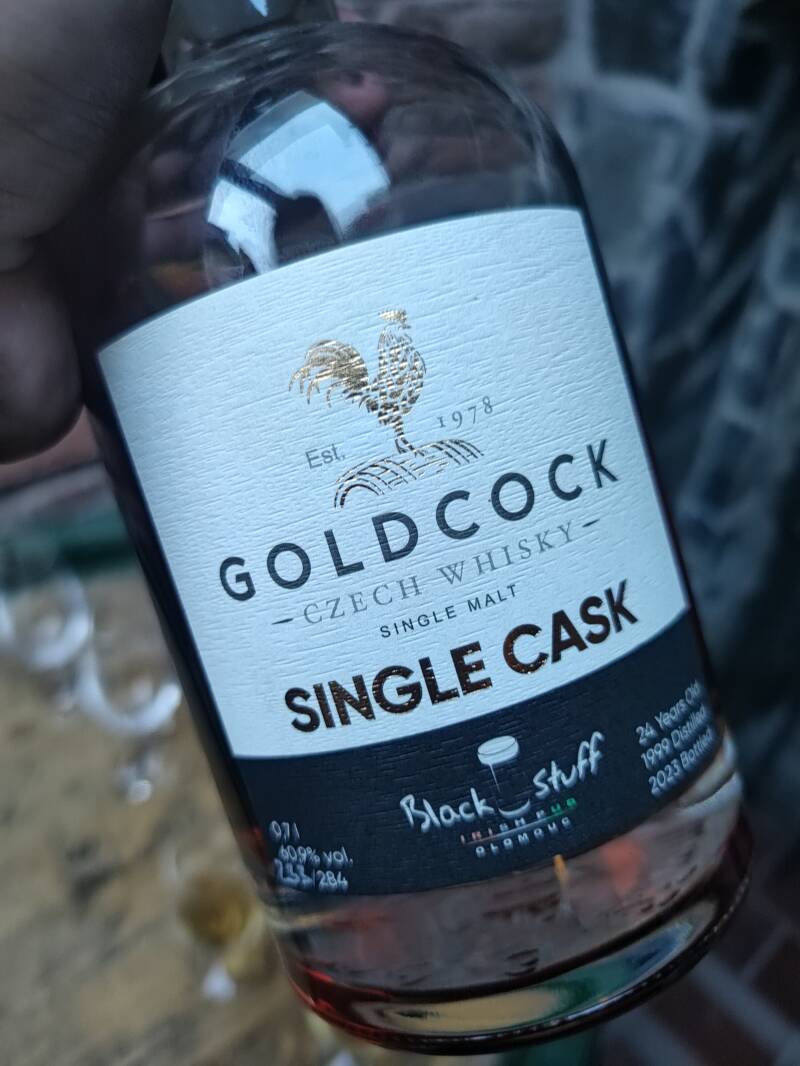


What were my final thoughts after this mammoth day of Czech whisky discovery: R. Jelinek, then TOSH, and finally The Black Stuff? Everything I saw and tasted in Olomouc showed me that Moravia really is a powerhouse of Czech whiskymaking. I learned how TOSH’s branding ties new craft-beer-age thinking into history stretching back to eighteenth century revolutionaries and sixteenth century monks. They’re approaching a new level of maturity with their whiskies, so I’m telling you now: keep an eye out for TOSH!

Add comment
Comments