


As soon as I finished my last distillery visit in Austria, I headed straight off to Czechia on the train. By 10pm, I managed to make it to the small town of Vizovice in eastern Moravia. A town of only 5,000 inhabitants, it’s also home to one whisky distillery, and it might be the single most important one in Czechia: Rudolf Jelínek.
Walking across from the town centre, I knew I was getting close when I passed an apple tree with this little flag stuck in it (above). You can see immediately that this is a large, industrial outfit, used to large groups of international visitors. Today, this is the home of Gold Cock whisky, which is a big deal for me. When I first moved to Eindhoven (just before starting EuroWhisky), I visited WhiskyLab (the shop I now work with) - and my first sample I tried there was Gold Cock Peated.
More than that, Gold Cock is just great whisky (in my opinion), and it's certainly one of the most important in the development of Czech whisky today.

Bear in mind that the main story of this distillery is fruit brandy. This is a BIG deal here - Jelínek owns 80 hectares of pear orchards in Chile, used purely for producing their Williams brandy. More importantly, they are the single largest producer of plums in the whole Czech Republic! Jelínek also owns Vinprom Troyan, makers of some of Bulgaria’s best renowned plum rakiya. The largest export market for Jelínek brandies is the USA, where they’ve had a presence in the market for 90 years.


I was met by Petra and Lukas, Jelinek’s hard working export managers. Lukas took me on the distillery tour, asking me to bear in mind that he is not a whisky expert. Fruit brandy is the distillery’s main product, and he isn’t a distiller himself, so that’s perfectly reasonable! For what it's worth, he was still absolutely able to answer most of my technical questions, so I think he was a little modest here.
We actually start with some history - one benefit of having a proper visitor’s center…
HISTORY
In a world of European distilleries only five, ten, maybe fifteen years old, Jelínek is something else entirely: there’s a depth of history you rarely see elsewhere. The first records for any distilling happening in the area date back to 1585, which is consistent with the broader history of Bohemia and Moravia. Refreshingly, Lukas doesn’t pretend this is somehow the start of this distillery, as companies are wont to do for marketing purposes - Jelínek started much later.

Mr Jelínek, an experienced distiller, came here to build a new distillery in 1894. In 1921, the family business was handed to his sons, Rudolf and Vladimir. Vlad was supposedly the responsible one of the two, and the company was split between the brothers at one point. Rudolf is the ‘R’ in the distillery’s modern name. At that time, Vizovice sat almost exactly in the dead centre of Czechoslovakia - I saw as much on an old map in the distillery’s visitor centre.
WWII brought disaster for the family. The Jelíneks were Jewish, and all were sent to Nazi death camps during the German occupation. Only one of Rudolf’s sons survived, and he died in 1946. The closest relatives left alive were some of Rudolf’s cousins, and they took over the company in his name. When the ČSSR was created in 1948-9, the distillery was nationalised but continued to export.


Forgive a brief history lesson, but it's worth noting as part of this whisky distillery’s history. Many forget that the ČSSR, despite the name and Warsaw Pact influence, was not at all like the USSR, nor did it stay the same from 1948 through to 1989. For the first twenty years, the ČSSR was relatively independent from Moscow’s influence, and Czechoslovaks retained much freedom of speech/press. Despite nationalisation not being the family’s choice, the distillery did well. After 1968, they would have felt the change (along with the rest of the country) as that level of independence was rapidly ripped away.


Gold Cock was first made in 1974, but not here. We’ll see more about this in another upcoming distillery visit, but the point is, Jelínek was still focused on fruit brandies. Gold Cock was made in Dolany, Bohemia. You might not have noticed (I never had!) that the logo actually shows the titular cockerel made of wheat, the idea being to show off the agricultural produce of the area. Much of this early Czech whisky was exported to the USSR - again, as part of the post-’68 Warsaw Pact. There was a green labelled 12 Year Old, and a red labelled Blend.


The company would only be fully re-privatised in 1994 (five years after the Velvet Revolution) by a group including Lukas’ own father. The splitting of Czechia and Slovakia made things quite tough in those years, as Jelínek had always done a lot of business in Slovakia. In 2003, Jelínek re-established their own 200 hectares of plum orchards. Today, Rudolf’s great grandson is still alive and kicking at the age of 85. He has, according to Lukas, a reputation as a bit of a ‘party beast’, even at this ripe age!

Fast forward to 2008, and the Gold Cock brand goes fully bankrupt. Jelínek bought up the name and old stock, the latter of which was their key concern. Realising they now held Czechia’s oldest stocks of whisky, Miroslav Motycka (who is still the company’s sales director) really pushed for Jelínek to start producing more whisky. Lukas makes it clear that the revival and re-cultivation of the Gold Cock brand is largely down to Motycka.
THE DISTILLERY
On to the distillery itself! We have to go further in from the entrance, and I see some small column stills. Lukas explains that these are 150 and 300 litre stills used for purely local batches of plums - a small fraction of total production, but it means Jelinek can create local craft products, a real treat for Moravian locals.

The warehouse they use for storing raw materials is enormous! As soon as we step into the main distilling building, the plum smell is potent! Large fermentation tanks here hold the fruit as it spends three to six weeks bubbling away. Jelínek distills all year round, but akin to Old Well’s seasonal shifts, all their fruit brandy production ends in December. They then shift to gin until March, and whisky in April.
These same large fermentation tanks are used for Gold Cock whisky wash (naturally, they are all cleaned in between those two!). As in the maturation warehouses, this warehouse has no temperature control. The seasonal temperatures of the Moravian spring therefore contribute to the fermentation of Gold Cock whisky. Lukas points to large pipes, explaining that the fermented fruit cannot be exposed to air before distillation. The wash therefore passes directly into the pot stills via these pipes.

DETAILS
- General purpose distilling yeast
- 1500L and 2000L steam heated hybrid stills (Holstein)
- Still columns have 3 or 4 plates (respectively)
- Only 2 plates used during whisky distillation
- Same stills used for whisky and slivova production
- 330L Czech oak casks
- 3.6% angels’ share
The distillery hosts multiple festivals on its extensive grounds, bringing both locals and many visitors to Vizovice. In the summer, 30,000 attend Masters of Rock, and of course, there’s a plum festival. The ‘Friends of Jelínek’ come for that, enjoying a sampling and taste test on a Friday before a week of celebrating the distillery’s signature product.
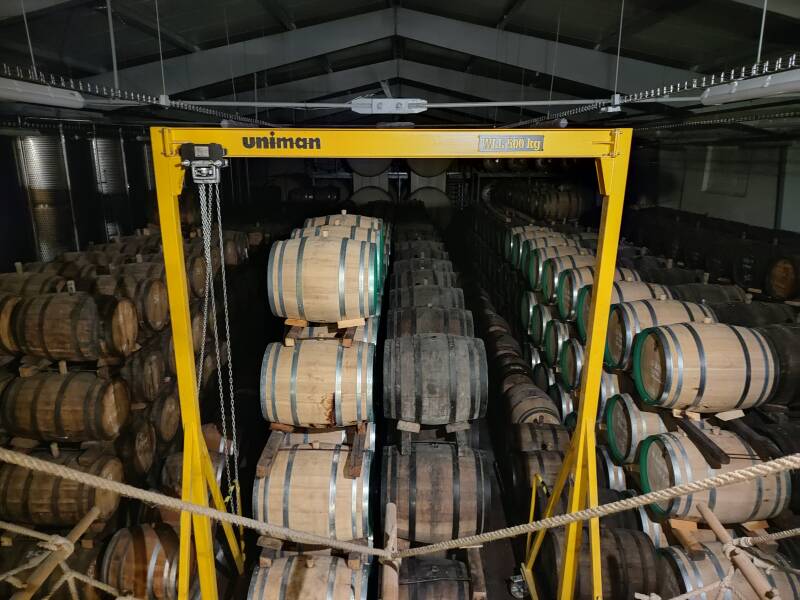

The maturation warehouse for Gold Cock currently holds 340 casks (approx. 112,000 litres). Much more than some microdistilleries I visit, but you can see how this is still very small for such an enormous brandy producer. These Czech oak casks are produced exclusively for Jelínek by a Czech cooper, and they also swap casks occasionally with Elijah Craig or Heaven Hill (which they distribute in Czechia). The fact these casks are unique is visible even to me - they’re squatter than most I’ve seen, and the overall size is distinctive.

Jelínek loves to bottle single cask expressions of Gold Cock, and they also promote the brand via thirteen Gold Cock embassies around the country. Akin to the Ardbeg and SMWS model, these bars must carry the full Gold Cock portfolio, and they get to select a barrel for their own exclusive bottling.

We also took a quick walk past an old mill building - this was only acquired by the company earlier this year. Currently under renovation, this building will become a dedicated Gold Cock distillery building once open.


We come to another room full of ageing brandy - different plum varieties- while massive stainless steel tanks are used for non-wood ageing next door. Lukas tells me that the five year aged slivovitz is Jelinek’s single bestselling product, and this spirit ages purely in these large steel tanks. One fascinating thing that caught my eye here was an apricot brandy aged in apricot wood! They were apparently very difficult barrels to make, even at only 30L in size. If you’ve ever seen how small an apricot tree is, you’ll understand…

TASTING

Returning to the offices, we sit back down with Petra to taste some drams from across the Gold Cock range. About 60% of the whisky made at Jelínek goes to domestic customers in Czechia, and Asia is the largest market for the rest. Gold Cock production has increased, but the distillery is still waiting for maturation. They aim to hit their ideal levels of stock ready for sale in about 7 to 8 years. The Blended Gold Cock exists to help fill this gap, and to reach a wider range of customers as a cheaper product.

Naturally, we start with the Blended Gold Cock. Made using three year old malt and six year old grain whisky, this 42% ABV dram has a light aroma to it. That’s surely to be expected from a blend, and I get an immediate hit of sweetness on the palate. It’s eminently drinkable, and has a little touch of peat too from some 10ppm malt. The finish is strong enough to round it all off. This blend is no afterthought - it does the job very nicely!

You might wonder what the grain whisky in that blend involves. It’s a wheat whisky, and you can now get this in a dedicated bottling, simply labelled Wheat. Bottled at the Vizovice strength of 49.2%, it comes from a mashbill of 50% wheat and 50% other grains, with some malt in there somewhere. These actually age in slightly different casks - older 260L Czech oak, previously used for the peated Gold Cock expressions. Only sold in Czechia at the moment, this dram has more of a sweet spice to it, comparable to an American whiskey. The peated cask adds an extra dimension - I’ve never tasted that alongside wheat before (a peated wheat, if you will). It’s a NAS, and the overall effect is comparable to a lightly peated single malt. Not as wheaty as I expected.

Gold Cock also have a 49.2% Rye, which I saw ages ago but no longer crops up much. Like the Old Well Rye, it’s a casualty of #RyeGate. If I didn’t know better and was trying this blind, I would imagine this was some five year old, light Speyside single malt - weird comment for a rye whisky, I know! 60% rye mashbill, fermented for five days before double distillation and just under five years ageing in ex-bourbon casks. There’s some sweetness at first, but the mouthfeel is super light. The palate is almost lemony, with only some spice in the throat indicating this was made with rye.

We then get to step up to a 12 Year Single Grain, also at 49.2%. This was originally intended only as a kind of placeholder. Emptying early bottles of single malt, Jelínek put some grain whisky in here just to keep the barrels wet. However, it became a surprise success, selling out quickly once bottled. It sure smells like a single grain, with a little hint of floral wheat (though less rich than a wheated US whiskey). Overall, a very good single grain with extra bite form the higher ABV and a consistent finish. Not much more to say, but I’m happy with it!

Remember I mentioned the single cask bottlings for Gold Cock embassies? Here’s one for Olomouc bar The Black Stuff. 60.8% ABV, 20ppm single malt, eight years old, and finished for one year in Pilsner Urquell imperial stout casks. It took me a second to get past the strong alcohol hit on the nose at first, but I was able to get something deep and nutty out of it after a while. The palate has a sweet hit to it at first, and then some peat comes through. While I wouldn’t say it has an obvious stout flavour, the whole thing is really cohesive. With water, it becomes extra sweet! More grainy notes fly out of it, but the whole thing stays quite peppery in the throat. No surprise, this was a great dram.


Finally, the impressively named Ultra Peated. 49.2% ABV and 60ppm - yes, 60! It has a slightly grey label that also makes it stand out a touch from the regular white labels for Gold Cock. Aged for only four years in Czech oak, this dram doesn’t have the pungent iodine of much Scottish peat, but it's certainly rich and coal-like. It’s sweet, fading to this perfect medium level of smoke after light fruit notes and a light body. It’s very reminiscent of Scotch malts, more so than any other Gold Cock I’ve tried. It’s all very contained - it doesn’t pour sulphury smoke into every corner of your mouth like an Islay malt. That cleaner note also means it isn’t very spicy in the throat. I really like it, but the irony is, it doesn’t taste ‘ultra peated’ at all - just really smoothly peated!

After all this tasting - and the rest of the visit! - I have to say this was a very different kind of visit. The closest thing I’ve had to this in the past was Scheibel, but their schnapps is made so removed from their whisky production that I didn’t see the two together like this. Both are situated in small towns reached by railcar branch lines - this is a great place for public transport access despite being so remote!
I enjoyed Vizovice, and the distillery even more so. Can't wait until they have that mill building up and running for Gold Cock. This is Czech whisky on a bigger scale than most can accomplish, and so far it has been handled responsibly. Let’s see how their changing range pans out, as they start increasing stock and production, but I have good reason not to worry.
The Blended really works, especially for its low price, and the Wheat was a nice surprise. The classic single malt is still probably my favourite from the range, but Gold Cock has a lot of lighter sides to it, more than I had realised. I would certainly recommend a visit if you get the chance, and try their whisky when you can!
Add comment
Comments